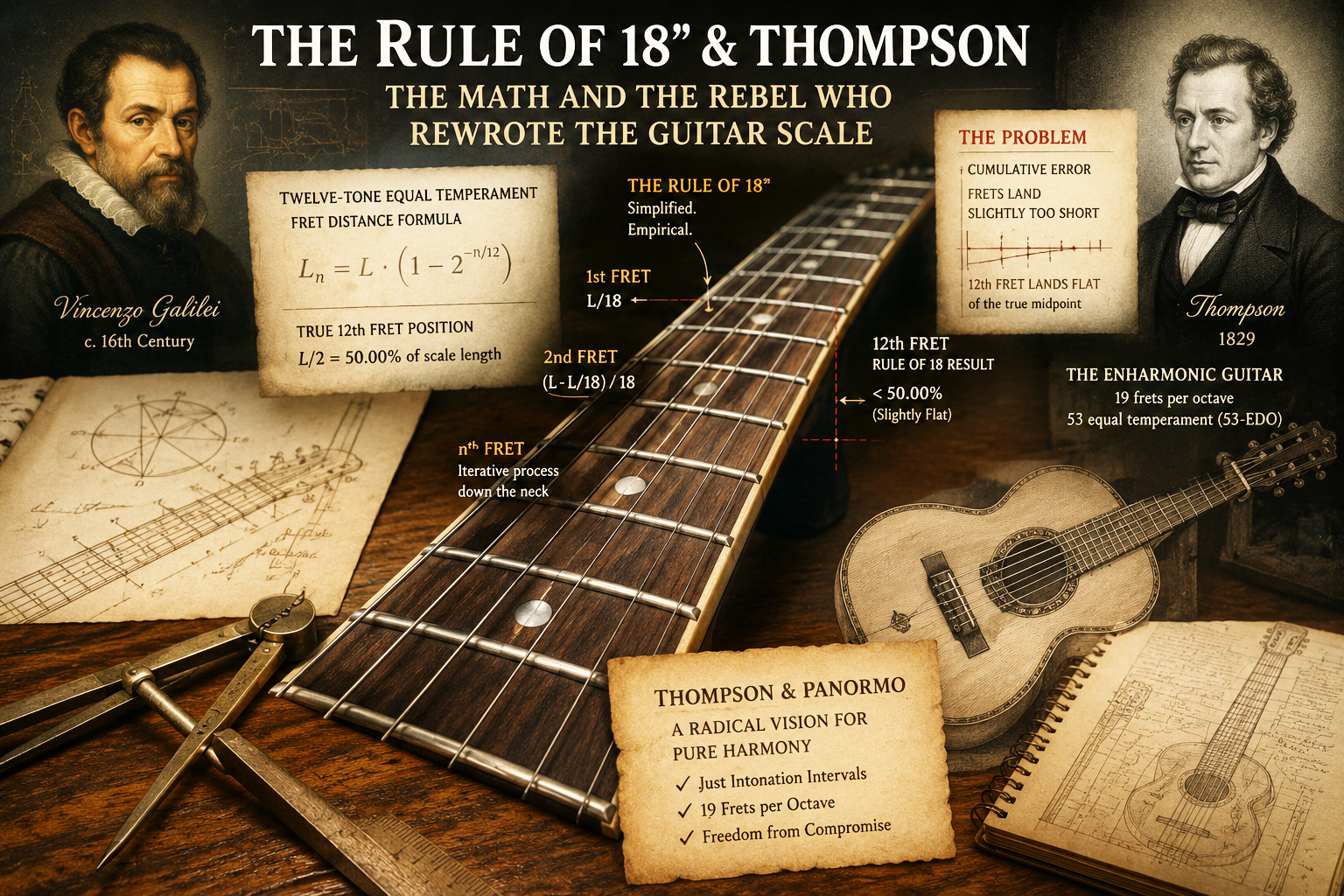
Guitar History • Fretboard Mathematics
The Fretboard’s Ancient Math: How Vincenzo Galilei and a Rebel General Rewrote the Guitar’s Scale
The wooden neck of a guitar looks like a monument to absolute order. Yet beneath this clean geometry lies a battleground between physical reality and mathematical ideals that has raged for over five centuries.
A series of straight, parallel metal frets divides the fingerboard into neat intervals, promising that a simple press of a finger will yield a perfect note.
The central problem of the guitar is that while the laws of acoustics demand fluid, dynamic adjustments, the modern fingerboard is a rigid, unyielding grid. To understand how the guitar arrived at this design, one must trace the instrument’s journey from the flexible, tied-gut frets of the Renaissance to a radical, nineteenth-century detour that attempted to abandon musical compromise altogether.
Section 1
The Era of the Tied Fret: When Geometry Was Fluid
During the Renaissance and Baroque eras, the guitar was not the standardized six-string instrument seen today. It evolved through a sequence of physical forms, starting as a four-course instrument in the sixteenth century, expanding to a five-course layout by the end of that century, and eventually consolidating into a six-string configuration in the early nineteenth century.
These early instruments inherited a vital characteristic from the lute family: they did not have fixed metal frets. Instead, their frets were literally made of animal gut tied securely around the wooden neck.
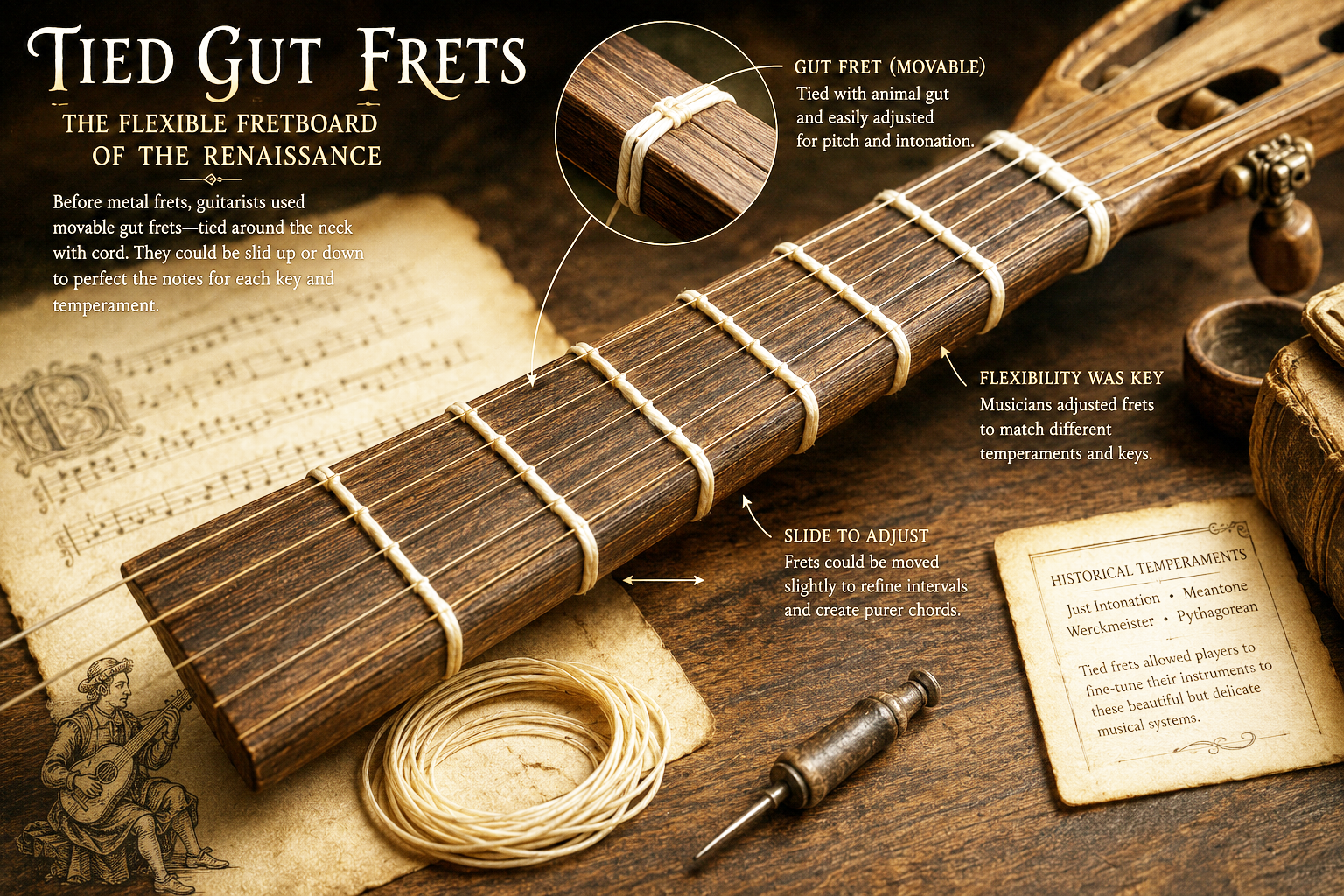
Tied-Gut Fret (Movable)
[Nut]=====[Fret 1]=====[Fret 2]=====[Fret 3]=====
             |---> Can be slid up or down to alter temperament
This structural choice provided a level of flexibility that modern guitarists would find both baffling and liberating. Because the gut frets could be slid up and down the neck, the player could alter the physical distance between intervals. This adjustability was crucial because Renaissance and Baroque music did not use the universal tuning system heard on modern radios.
Instead, musicians relied on historical temperaments, such as “just intonation” or “meantone temperament,” which prioritized the mathematical purity of chords in a small selection of musical keys. If a piece of music shifted from a key with pure major thirds to a key that sounded harsh and unplayable, the musician simply adjusted the gut frets to redistribute the pitch errors.
Section 2
Vincenzo Galilei and the Mathematics of Compromise
As Western music evolved, composers began writing complex pieces that modulated rapidly through different keys. This musical shift made tied gut frets increasingly impractical, as musicians could no longer stop performance mid-song to slide their frets. The instrument needed a permanent fretboard, which required a single, fixed mathematical system to divide the octave.
The solution was Twelve-Tone Equal Temperament, often shortened to 12-TET. Equal temperament is a mathematical compromise. It sacrifices the perfect purity of natural intervals to ensure that all twelve notes in an octave are spaced at exactly equal ratios. This uniform spacing allows an instrument to play in any musical key without sounding out of tune.
This transition was championed in the sixteenth and seventeenth centuries by key scientific and musical figures, including Marin Mersenne, Simon Stevin, and Vincenzo Galilei—the father of the famous astronomer Galileo Galilei.
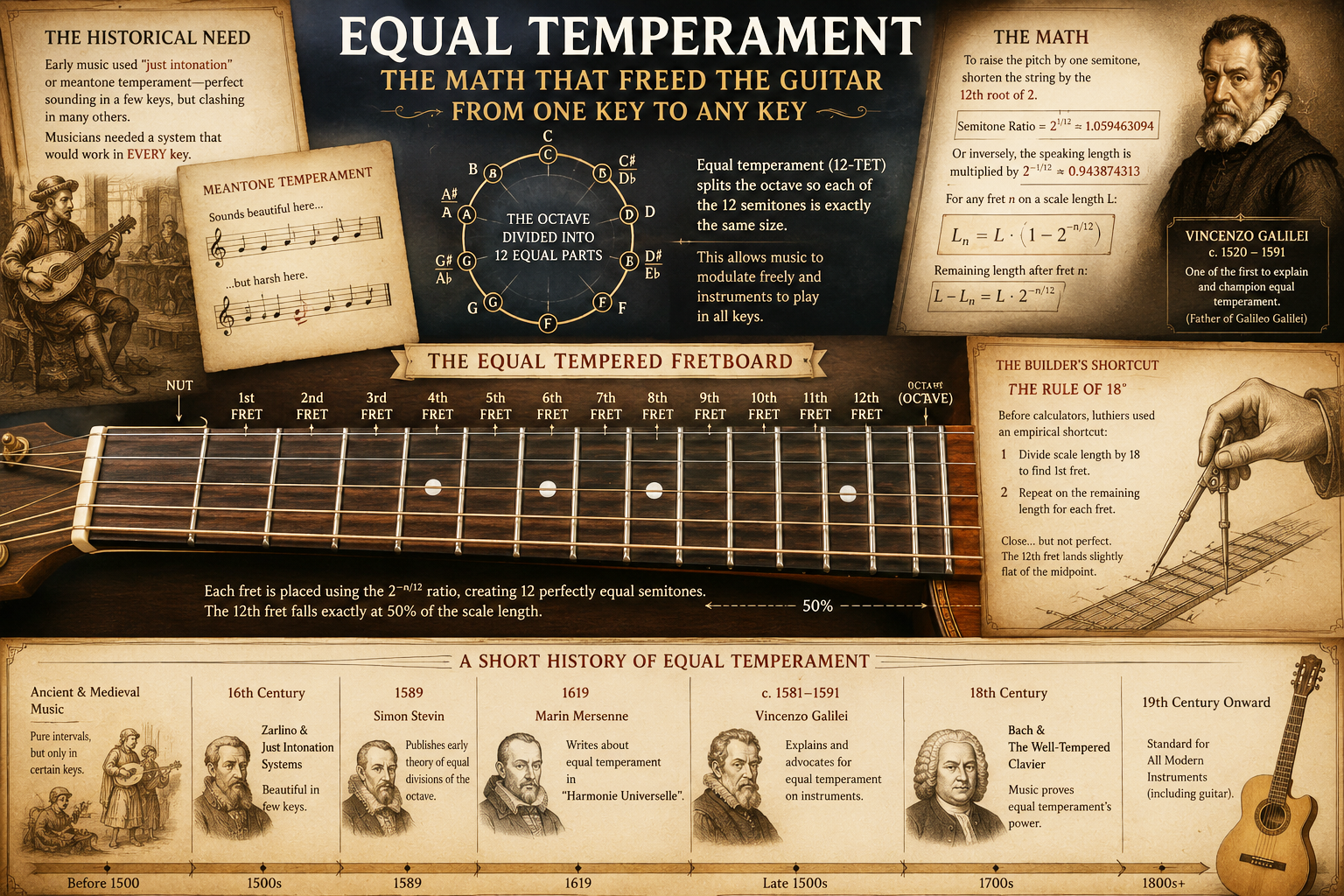
Fixed Fretboard Geometry
To implement equal temperament on a fixed fretboard, the physical position of each fret must follow a precise geometric progression.
dn = L − L / 2n/12 Ln = L / 2n/12In plain language: each semitone shortens the vibrating length of the string by the same ratio.
Section 3
The Rule of 18 versus the Modern Divisor
Long before modern calculators or computer-guided machinery, luthiers needed a practical, reliable way to lay out these fret lines using simple shop tools. This practical need led to the adoption of the “Rule of 18.”
The Rule of 18 was an empirical shortcut. To locate the first fret, a builder would divide the total scale length by 18, placing the first fret at that distance from the nut. To find the second fret, the builder would subtract the first fret’s distance from the total scale length and divide the remaining length by 18. This iterative process was repeated down the neck.
This formula was easy to calculate with a pencil and paper, or even with a mechanical device called a proportional divider. However, because the fraction yielded a multiplier of approximately 0.944444, while the mathematically true equal-tempered semitone multiplier is approximately 0.943874, the Rule of 18 contained a subtle mathematical error.
This fractional difference meant that as a builder moved down the fretboard, the cumulative error would cause the frets to be placed slightly too close to the headstock. Most notably, the 12th fret—which represents the exact octave and must fall at the precise physical midpoint of the scale—would land slightly flat of the center.
To correct this error, modern luthiers adjusted the divisor from 18 to the highly precise constant of 17.817. This mathematical refinement ensures that the 12th fret aligns perfectly with the physical midpoint, resolving the cumulative error of the old workshop method and bringing the modern fixed fretboard into true acoustic alignment.
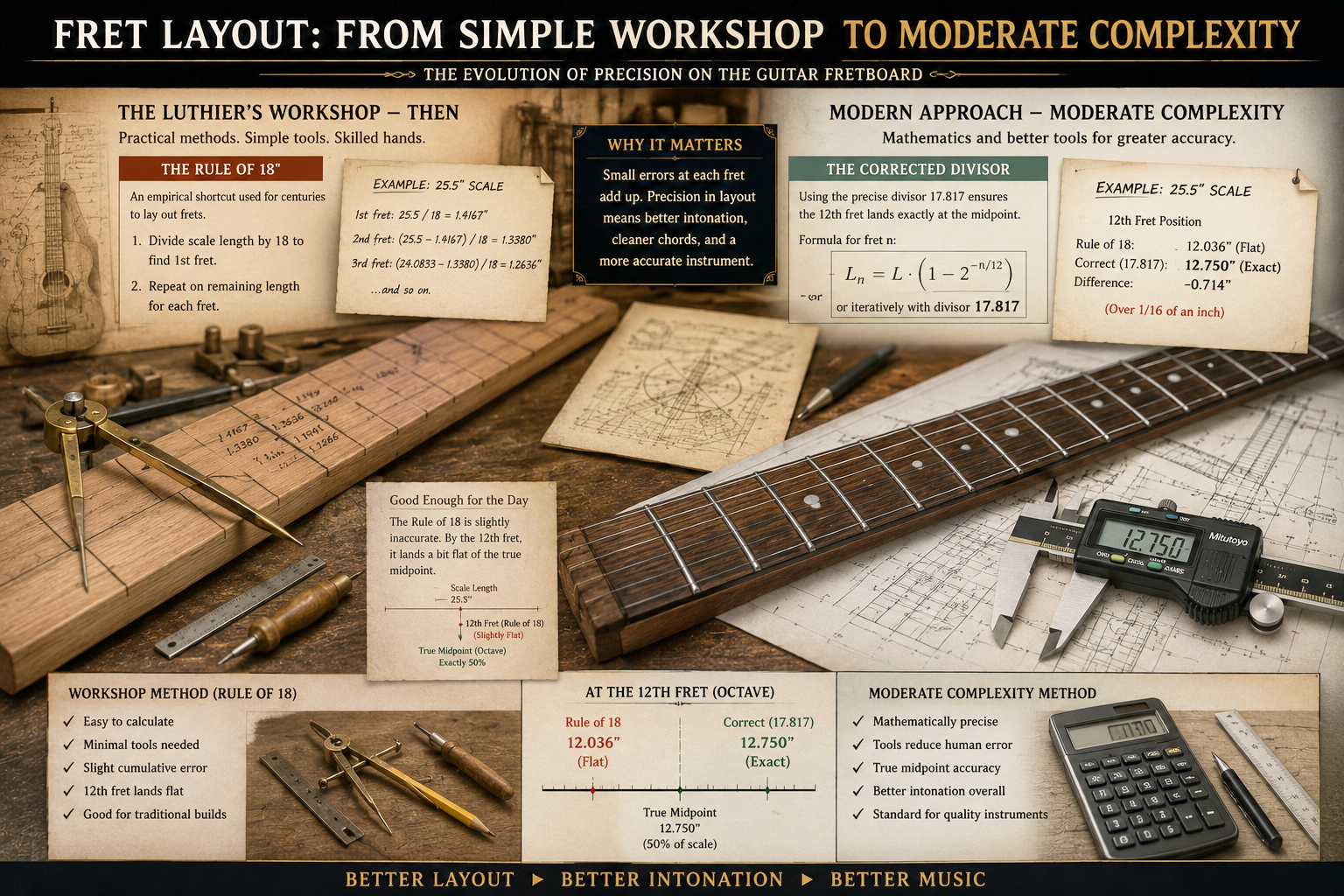
| Fret Layout System | Step-by-Step Divisor Formula | Calculated Multiplier | 12th-Fret Physical Midpoint |
|---|---|---|---|
| Mathematical True 12-TET | Ln = L · 2−n/12 | ≈ 0.943874 | Perfectly at 50.00% of scale length |
| Historical “Rule of 18” | Remaining length × 17/18 | ≈ 0.944444 | Shifts flat, failing to reach the physical center |
| Modern Corrected Divisor | Remaining length ÷ 17.817 | ≈ 0.943874 | Aligns precisely at 50.00% of scale length |
Section 4
The Rebel and the Builder: Thompson’s Enharmonic Guitar
While equal temperament became the industrial standard for fixed-fret instruments, it was not universally embraced. Many musicians and theorists felt that equal temperament robbed chords of their natural, pure resonance. This dissatisfaction led to one of the most radical experiments in guitar history: the collaboration between General Thomas Perronet Thompson and the legendary London guitar maker Louis Panormo.
Thomas Perronet Thompson, a fellow of Queens’ College, Cambridge, was a brilliant mathematician who was obsessed with escaping the “compromise of temperament.” He argued that a fretted instrument could, and should, play with the pristine harmonic intervals of just intonation.
To prove his theory, Thompson partnered with Louis Panormo, the premier guitar maker in nineteenth-century London. Panormo was a pioneer who built instruments in two distinct styles: French-style instruments with ladder-braced spruce tops and Spanish-style instruments with fan bracing and natural-finished Spanish cedar necks.
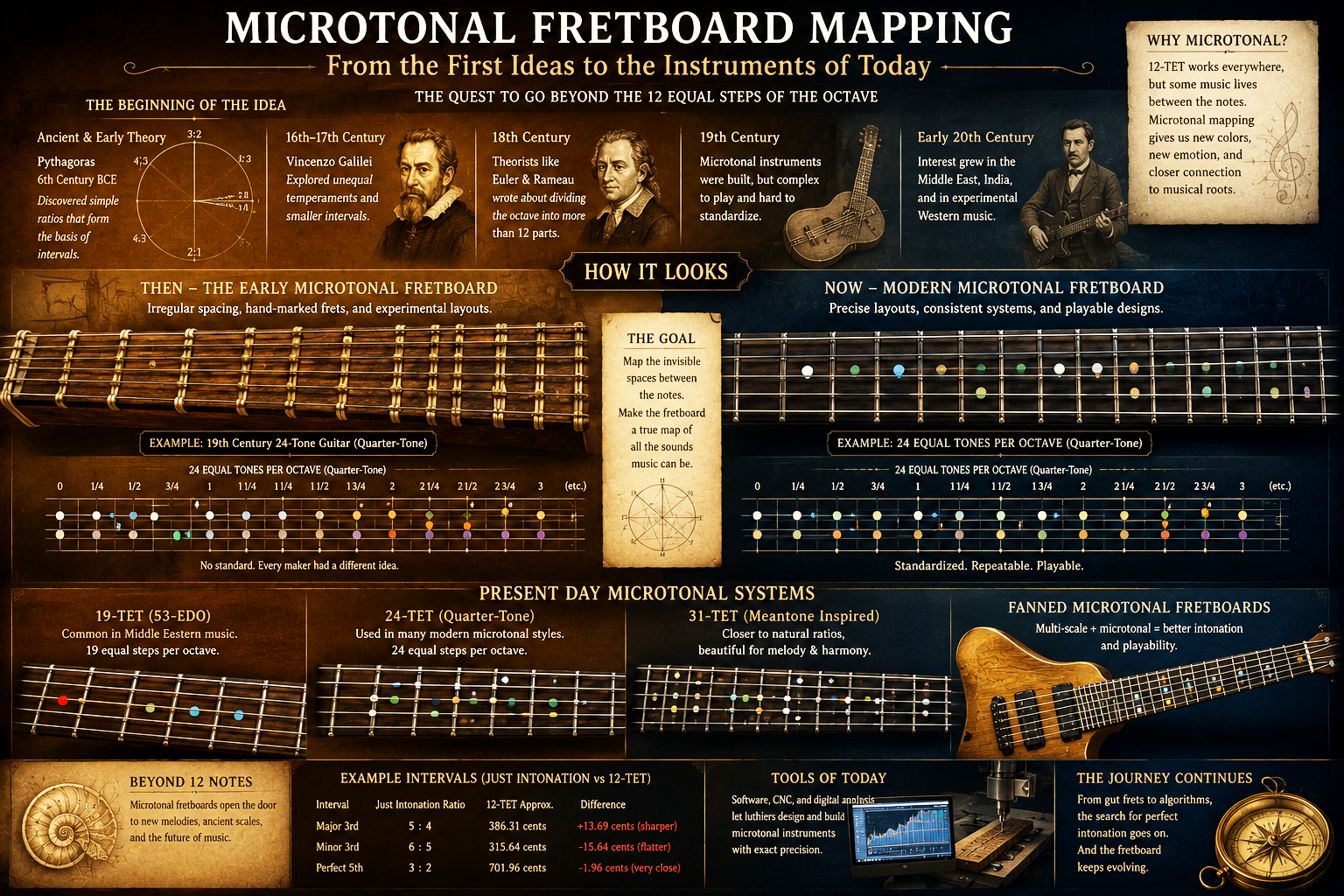
In 1829, Panormo constructed a highly customized Spanish-style instrument for Thompson: the Enharmonic Guitar, bearing serial number 1766. Rather than dividing the octave into twelve simple semitones, Thompson’s design divided the fingerboard into fifty-nine distinct parts per octave to accommodate the complex requirements of 53 equal temperament.
This microtonal division allowed for practically pure perfect fifths, flat by a mere 0.1 cents, and major thirds that landed within 1.4 cents of a perfect natural harmonic ratio, while tempering out both the acoustic schisma and the kleisma.
Thompson's Enharmonic Guitar Fretboard (Conceptual)
========================================= [Nut]
--[o]----[o]----[o]----[o]----[o]--  Individual croquet-hoop frets
----[o]----[o]----[o]----[o]-------  inserted into mapped holes
------[o]----[o]----[o]----[o]-----  to isolate specific string pitches
========================================= [Neck Edge]
To play these ultra-pure intervals, Panormo and Thompson had to discard traditional, straight frets. The Enharmonic Guitar featured a fingerboard drilled with hundreds of small holes. Instead of single fret rods running across the entire neck, the instrument used small, individual metal frets shaped like “croquet hoops.” Each little hoop was wide enough to serve only one string.
The majority of these frets were made of blue-tempered steel. When a musician shifted keys, they would insert additional brass or white-finished frets into specific pre-mapped coordinates on the board to align the scale with the new root notes. The headstock carried a small plaque indicating the chosen key, such as the key of A.
Thompson published these design principles under a protective pseudonym in his highly technical 1829 manual, Instructions to my Daughter, for playing on the Enharmonic Guitar. While Panormo advertised and sold a small number of these instruments, their extreme mechanical complexity and the intense physical demands they placed on the player prevented them from achieving widespread popularity. No known physical examples of the Enharmonic Guitar have survived to the present day.
Q&A
Questions Players Ask About This Topic
Closing Thought
The Straight Fret Was a Compromise
Nevertheless, this radical historical experiment proved that the modern guitar’s simple, straight-fretted neck was never an absolute, perfect design. Instead, it was simply the most practical compromise that musicians and builders agreed to accept.
Back to Top